Bifröst University hosts major conference on Arctic and European security
The Arctic has rapidly evolved from a remote peripheral region into an area of growing strategic importance, where superpower politics, climate change, digital infrastructure and hybrid threats increasingly intersect. These issues were at the centre of discussions at the conference New Frontiers of European Security: The Arctic and the European Periphery, hosted by Bifröst University at the Nordic House on 13 May.
The conference brought together academics, policymakers, diplomats and defence experts from across Europe and beyond. The event attracted a strong on-site audience, with several hundred additional participants following the discussions via livestream.
War, climate and changing security priorities
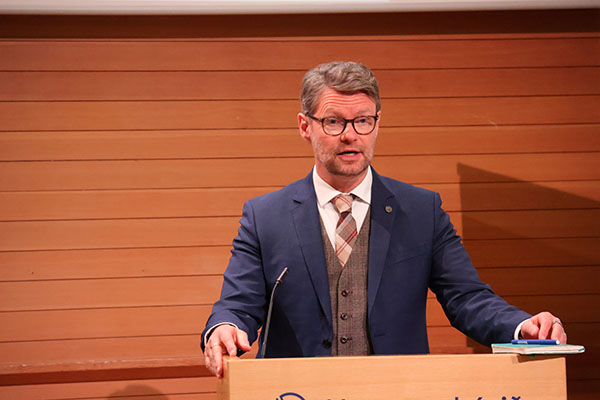
In her opening address, Bifröst University Rector Dr Ólína Kjerúlf Þorvarðardóttir discussed how Russia’s war against Ukraine has fundamentally altered Europe’s security landscape, reshaping threat assessments and exposing vulnerabilities extending beyond traditional borders into maritime routes, airspace and cyberspace.
“Security is not a purely military matter but a systemic one; it concerns resilience, governance, cooperation and dialogue, as well as the capacity to make decisions under uncertainty,” said Þorvarðardóttir.
She noted that for a country without a military, such as Iceland, questions of security, defence and peace are far from theoretical. Iceland’s security, she said, depends on strong alliances and international cooperation. She added that one of the conference’s key aims was to translate academic analysis into long-term policy development and structural resilience.
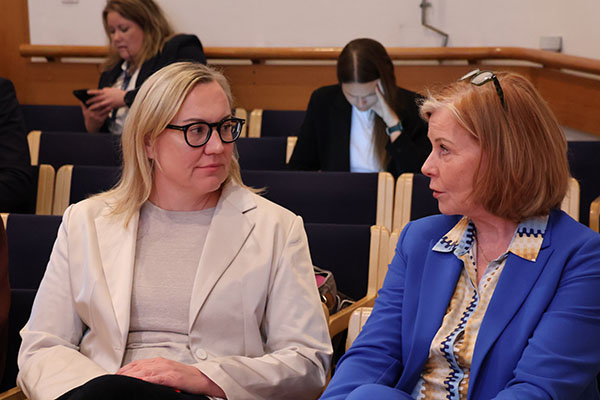
Minister of Justice Þorbjörg Sigríður Gunnlaugsdóttir welcomed what she described as a more open public discussion on security matters in Iceland. She emphasised the importance of responding to the world as it is, rather than as nations might wish it to be, and outlined measures being taken to strengthen Iceland’s civil protection infrastructure, the Coast Guard and the police force as the country’s first line of defence.
Among the developments highlighted were:
- Iceland securing access to the EU’s encrypted satellite communication systems GovSatCom and IRIS²
- the approval of Iceland’s first security and defence policy by the Alþingi earlier this year
- ongoing work to replace the country’s ageing TETRA communications network with a next-generation system
Lessons from Ukraine and emerging hybrid threats
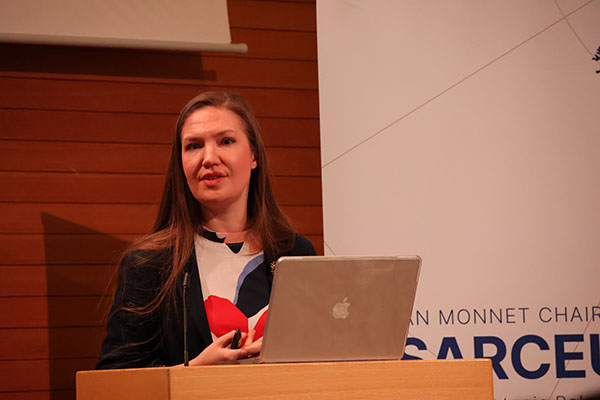
One of the conference highlights was a presentation by Dr Victoria Vdovychenko from Ukraine, who introduced the concept of the “in-between epoch”. She described how adversaries of the West, including what she termed the CRINK alliance — China, Russia, Iran and North Korea — increasingly combine military, economic and cognitive tools.
Vdovychenko explained that Ukraine has relied on three forms of asymmetry in its defence strategy:
- technical asymmetry, including the production of more than 2.5 million drones annually, most of them manufactured domestically
- organisational asymmetry through decentralised and flexible decision-making structures
- cognitive asymmetry through the rapid integration of artificial intelligence, algorithms and data analytics into defence systems
Cybersecurity and critical infrastructure
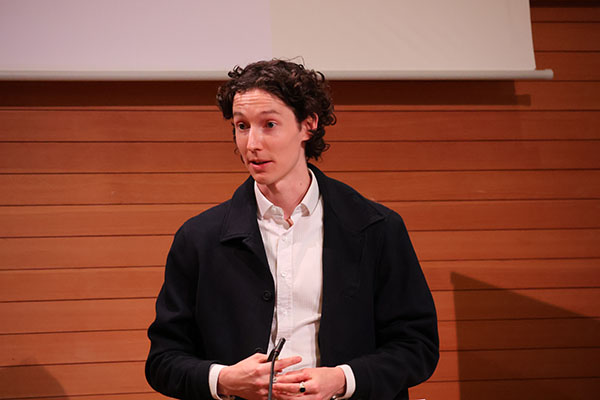
Aðalsteinn Jónsson from CERT-IS challenged the perception that Iceland is too small or geographically isolated to become a target for cyber-attacks. He pointed to the attacks directed at Icelandic government websites and electronic identification systems during the Council of Europe summit in Reykjavík in 2023 as a significant turning point.
CERT-IS currently handles more than 5,000 cybersecurity incident reports annually — approximately 14 every day. Jónsson described an increasingly sophisticated cybercrime ecosystem and highlighted emerging threats such as phishing attacks carried out through compromised trusted contacts, where authentication tokens can be hijacked in real time.
He also raised concerns about the vulnerability of Iceland’s three submarine communications cables. Referring to a recent contingency exercise, Jónsson noted that if all three cables were severed during severe weather conditions, repairs could take months. Satellite backup systems, he warned, would only be capable of handling a fraction of the country’s communications needs.
Looking ahead, Jónsson argued that artificial intelligence is rapidly transforming the cybersecurity landscape. The time between a security vulnerability being identified and exploited is expected to shrink dramatically over the coming years.
European perspectives on Arctic security
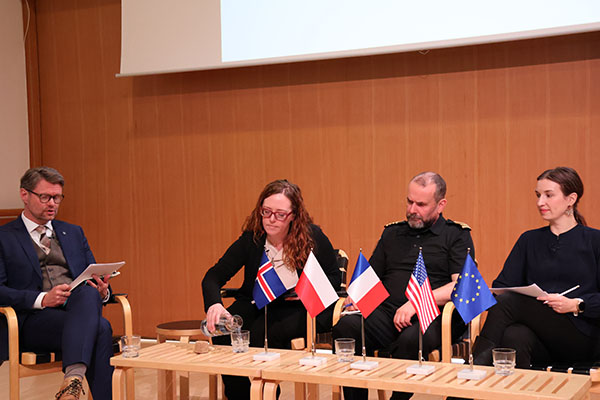
International speakers further underscored the growing strategic importance of the Arctic and the need for international cooperation.
Clara Ganslandt of the European Union outlined the new EU-Iceland security and defence cooperation agreement signed on 18 March and reaffirmed continued European support for Ukraine.
Antoine Michon of France discussed growing concerns over Russian military activity in the Arctic and China’s ambitions as a self-described “near-Arctic state”. He noted that France is strengthening its operational capabilities in the region, including the deployment of transport aircraft adapted for Arctic conditions.
Polish Ambassador Aleksander Kropiwnicki highlighted Poland’s long-standing scientific presence in Svalbard and stressed the importance of protecting the region. He also noted that Poland is allocating nearly 4.8% of its GDP to defence this year and welcomed Iceland’s recently adopted security strategy. In addition, he pointed out that Iceland will assume the presidency of the Council of the Baltic Sea States from Poland on 30 June.
Domestic resilience and risk management
Auðunn Kristinsson from the Icelandic Coast Guard described the organisation as an essential bridge between civil society and defence infrastructure. He highlighted the strategic importance of monitoring the GIUK gap — the maritime area between Greenland, Iceland and the United Kingdom — across a search and rescue zone covering approximately 1.9 million square kilometres.
To meet these growing challenges, the Coast Guard is working to integrate artificial intelligence into its command centres and is developing a new diploma programme in maritime security and defence in partnership with Bifröst University and Reykjavík Technical College.
Risk management expert Sóley Kaldal concluded the presentations by describing the Arctic as “Europe’s risk laboratory”. She pointed out that much of the region’s infrastructure is dual-use due to high operating costs: ports serve both fishing fleets and military vessels, while satellite stations support civilian telecommunications as well as intelligence operations.
Kaldal urged European nations to invest actively in Arctic infrastructure to ensure that the future of the region is not shaped solely by external actors with competing strategic interests.
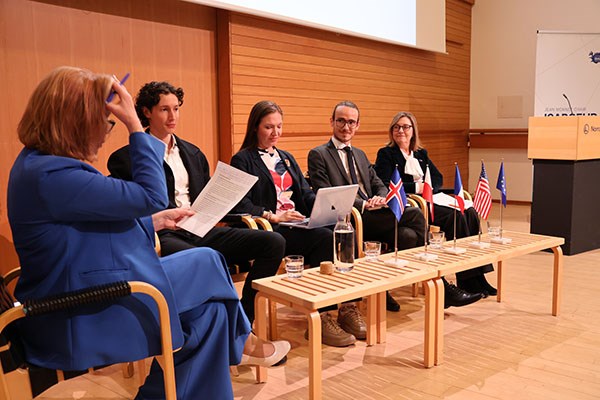
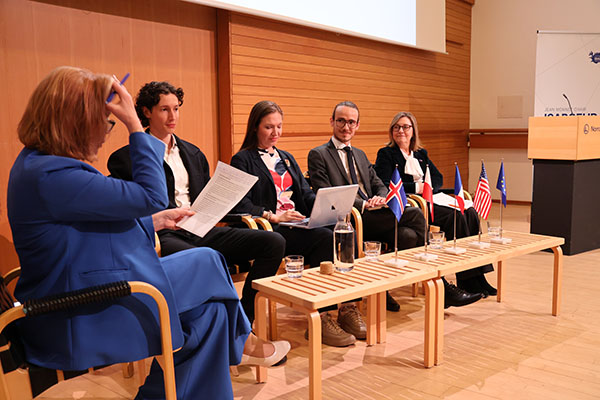
The conference concluded with a lively panel discussion involving speakers and participants. Discussions throughout the day highlighted the growing strategic importance of the Arctic and underlined the need for continued international cooperation on security, resilience and regional stability.